Saturday, August 18, 2007

Court Cuts Jail Terms of 3 Vietnamese Activists


A Vietnamese appeals court reduced the sentences to three men convicted and jailed in May for spreading "propaganda against the state". (Reuters)

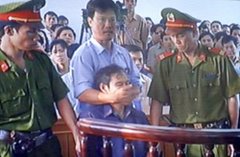
A Vietnamese appeals court on Friday reduced the sentences handed to three men who were convicted and jailed in May for spreading "propaganda against the state" and forming a political party.

A lawyer for one of the defendants said the court in Ho Chi Minh City ruled that Le Nguyen Sang, 48, a doctor, should serve four years instead of five years.

The trial in May was one of four this year in one-party ruled Vietnam of political activists who called for a multi-party system and greater freedom of speech, mostly over the Internet.

The sentence of businessman Nguyen Bac Truyen, 39, was reduced to three years from four years and another businessman, Huynh Nguyen Dao, 39, to two years from three years, said Truyen's lawyer Trinh Vinh Phuc.

The court concluded that the actions of the three men did not lead to any tangible consequences, the lawyer said.

At their Ho Chi Minh City People's Court trial in May, the three men were accused of using the Internet "to sow discontent among the public" and creating the People's Democratic Party to organise protests, including during last November's visit of U.S. President George W. Bush.

The outlawed People's Democratic Party is one of a few that emerged last year and carried information, mostly on the Internet, calling for alternatives to one-party rule in Vietnam.

Prosecutors linked the defendants to a Vietnamese-born U.S. citizen, Cong Thanh Do of San Jose, California, who was expelled from communist-run Vietnam last September. Do was accused of advocating the government's overthrow.

The People's Democratic Party, in an email received on Friday, called for the release of the three men and others under detention.
The Vietnam government says it does not charge people for their political views, only those who break the law. It is a criminal offence in Vietnam to disseminate views the government considers anti-state or opposed to the ruling Communist Party.

Hanoi rejects accusations by Western human rights groups of cracking down on dissidents after it successfully hosted an Asia-Pacific summit, won World Trade Organisation membership and was removed from a U.S. religious rights blacklist in 2006.

Vietnam newsletter says 'under attack'

HANOI, Aug 17, 2007 (AFP) - The Australian publisher of an email newsletter in communist Vietnam said Friday the media company was "under official attack" after carrying news articles with political content.

Police in Hanoi have investigated www.intellasia.com for allegedly operating without a proper license while a state-controlled newspaper Friday accused it of spreading "illegal" and "reactionary" content.

"Intellasia has been a very active promoter of investing in Vietnam for many years now," Australian proprietor Jonathan Leech said in an online statement. "But unfortunately today, August 17, Intellasia is under official attack."

The publication -- which has a Hanoi office and emails digests of mainly financial but also general news -- said they had been subject to "six weeks of harassment and interrogation."

State media reports said Intellasia "illegally operates a website without a license," and they showed images of the site carrying news agency reports, some about court trials of Vietnamese political dissidents.

The police-run newspaper An Ninh Thu Do said: "For years, the website has operated illegally and posted many distorted and reactionary articles about Vietnam's politics, human rights and democracy."

It said the business license granted by the Hanoi Department of Planning and Investment only allowed it to operate "in the fields of advertising, commerce, market news provision, consultancy for information and informatics sector."

Leech, the proprietor and editor, said the website is run from a US-based server, its content is managed by a US company, and it is "owned and operated by two Australians, one in Vietnam and the other in Australia."

"Intellasia has always endeavoured to present a fair picture of what is happening in Vietnam during the good and lean times over the years," Leech wrote. "But now that the country has joined the WTO (World Trade Organisation), things have suddenly reverted ominously."

"This is a very dark day for what should be a civilised country to operate in," wrote Leech. "And it should be noted that any foreigner or foreign organisation here in Vietnam that also operates a website abroad could at any time suddenly find themselves in a similar position of persecution."

US envoy leaving Vietnam calls rights issue disappointing


The outgoing US ambassador to Vietnam, Michael Marine, on Thursday said a lack of progress on human rights in the communist country was the biggest disappointment of his three-year tenure.

"I wish I could say it's improving, but I can't," he told his final media briefing in Hanoi. "Perhaps my biggest disappointment here is that we've not been able to expand the space for political dialogue in Vietnam."

Vietnam, a one-party-state, this year jailed a number of political activists who had called for non-violent political change toward a multi-party democracy, drawing protests from the United States and other countries.

Rallies dogged a June US visit by President Nguyen Minh Triet, the first to the United States by a Vietnamese state leader since the war ended in 1975.

Marine said religious freedoms had recently been expanded in Vietnam but he added: "If we are talking about the ability of people to engage in political activism, I can't be as positive, and in fact I'm a bit discouraged."

He pledged that the United States would keep up the human rights dialogue with Vietnam under his successor Michael Michalak, due to arrive this month.

"We have a long-term commitment to this, it is in Vietnam's interest for this to happen, and I believe it will happen," he said. "The question is when."

Vietnam's government says it does not punish dissidents, only people who break its laws, including the charge of spreading propaganda against the state, under which several dissidents were imprisoned this year.

Marine said: "To the extent that we are able to understand the Vietnamese legal system, there are laws on the books that allow the authorities to move against people for expressing their opinions, for organising in any way and for calling for political change.

"Those are fundamental human rights that I strongly believe are universal and should be enjoyed by the people of Vietnam."

The ambassador praised growing bilateral trade relations that were fully normalised last year, weeks before Vietnam -- an economy now growing at over 8 percent a year -- joined the World Trade Organisation in January.

"Economically, Vietnam is making major strides forward," said Marine. "The value of US-Vietnam two-way trade will exceed 10 billion dollars this year.

"The United States is Vietnam's top export market and its fourth largest foreign investor, and Vietnam expects to attract at least 15 billion dollars in foreign direct investment commitments this year."

Thursday, July 19, 2007

Vietnamese police break up land protest after 27 days


Author : DPA

Hanoi - Vietnamese police in riot gear broke up a demonstration of hundreds of people in Ho Chi Minh City who were demanding compensation for their seized land, witnesses said Thursday. After tolerating the long-running protest for 27 days, armed police moved in late Wednesday night to the tented camp outside the National Assembly offices, forcing the protesters onto buses bound for their home provinces. One of the protesters said the dispersing was peaceful.

"Police yanked down all the tents, banners and signs. They ushered groups of protesters onto one bus until it was full and then they started filling the second bus," a protester named Sinh told New Horizon radio.

"They did not have to beat anyone because no one had the strength to resist," Sinh added.

The crackdown came on eve of the National Assembly's scheduled session and a day after prominent dissident monk Thich Quang Do visited the protest and called for an end to the Communist Party's sole rule.

The demonstration of more than 500 people was the longest-running protest in Vietnam for years and had been publicized by overseas opposition groups as a sign of discontent with communist rule.

The protesters - from several Mekong Delta provinces - were demanding compensation for land that had been confiscated by local officials for development projects.

Signs and banners at the demonstrations accused local officials of "betraying the [Communist] Party and cheating the people." Other banners appealed directly to Prime Minister Nguyen Tan Dung to "save the people."

Land protests have become more common in Vietnam , with state media saying property disputes account for 85 per cent of complaints against the government.

On Tuesday, dissident Buddhist monk Thich Quang Do made a rare public appearance to support the demonstration and urged the protesters to also demand multi-party democracy.

Thich Quang Do, the deputy leader of the banned Unified Buddhist Church of Vietnam (UBCV), delivered 300 million Vietnamese dong (about 20,000 dollars) to the demonstrators on Tuesday for food.

Wednesday, July 18, 2007

Vietnam hit by mass land protests


A mass protest over the Vietnamese government's land policies is gathering force, ahead of the opening session of the newly-elected National Assembly.

Witnesses say hundreds of peasants from the Mekong River Delta are surrounding the offices of the National Assembly in Ho Chi Minh City.

A smaller protest is also reportedly being held in the capital, Hanoi.

The protesters are demanding the return of their land, and for any wrongdoing by local officials to be punished.

Both protests have been going on relatively peacefully for several weeks, and received little coverage in the local media.

However, as the protest in Ho Chi Minh - Vietnam's second city and the main economic hub - has hotted up in the last few days, residents have started complaining about traffic disruption.

Land protests are not unseen in Vietnam, but correspondents say a demonstration of this scale and intensity is rare.

Frequent complaints

Security forces have begun to get involved to make sure the protest does not get out of control.

Local officials in the Mekong Delta provinces have been urged to come to Ho Chi Minh City to "persuade their people to go home", with promises that their complaints will be dealt with appropriately.

Meanwhile, a deputy minister of security was quoted by state media as saying that there had been a certain involvement of "reactionary forces overseas".

Last Sunday, Deputy Prime Minister Truong Vinh Trong called an urgent meeting with provincial leaders.

He asked for a prompt investigation into the case and warned that the Communist Party would not tolerate inappropriate measures.

Land seizures in the name of economic development have been a much-debated topic in Vietnam, where the state maintains the sole ownership of land.

Peasants frequently complain about unfair compensation and criticise the laws on land use, which in their opinion have too many loopholes and are easily abused by corrupt local government officials.

The new 500-strong Vietnam National Assembly, elected last May, is to begin its first session on Thursday in Hanoi.

With the mass protest intensifying outside, the deputies will no doubt have many things to debate.

Sunday, July 15, 2007

Vietnamese peasants protest over land policy,graft


HO CHI MINH CITY, July 11 (Reuters) Scores of peasant farmers have protested for three weeks outside a Vietnamese government building over land appropriation for development, one of the longest-running demonstrations of its kind in Vietnam.

Some protesters accuse provincial officials of corruptly taking money from developers riding a boom in an economy that is one of the world's fastest-growing after China, but which is also showing signs of widening the gap between rich and poor.

For the past decade, small landowners from the provinces have gone to the main urban centres of Ho Chi Minh City and the capital, Hanoi, complaining that the communist-run government had failed to pay them adequate compensation for their land.

A report by the Mekong Economics consultancy said a ''concern is that a significant elite class in urban and some rural areas has emerged.

''Most Vietnamese want to be wealthy, and this is certainly not a crime,'' it said. ''But if wealth often comes or is perceived to often come from networks of patronage and corruption, that can lead to social instability.'' Demonstrations take place under police scrutiny and have been mostly peaceful, although there was one reported case of self-immolation by an elderly woman in Hanoi in 2005.

For the past week, groups of demonstrators have camped out in a park in Hanoi as the Communist Party Central Committee held a plenary session on administrative reforms. Next week, the newly elected National Assembly opens an inaugural session.

One woman demonstrator, Huynh Thi Trong from the far southern province of Ben Tre, said her dispute was with local council officials she accused of taking her 15,000 square metres of land.

NO SETTLEMENT ''I have sent petitions but there have been no invitations to settle this matter, so I came to Hanoi,'' Trong wrote in documents to officials, copies of which she handed out in the park.

In Ho Chi Minh City, farmers sat or lay in 32 degree Celsius (90 F) heat and humidity under red, white and blue tarpaulin sheets strung up at the door of a National Assembly office.

The protesters, from seven provinces, have tied a row of red and gold-starred Vietnamese flags, red and white banners and a portrait of independence leader Ho Chi Minh along a fence in front of the building. They began their protest three weeks ago on June 22, a spokeswoman for Viet Tan, an overseas Vietnamese organisation backing them said.

Usually such protests last only a few days days.

The demonstration northwest of central Saigon was closely monitored by uniformed and plainclothes police on a busy street that has a church and shops repairing motorbikes and selling floor tiles and other goods.

Police politely asked a Reuters reporter to leave the scene.

''The government says what these people are doing is not good and you should leave,'' a uniformed policeman said in English.

The issue of re-appropriation of land and the demonstrations is sensitive enough that it is not routinely reported in Vietnamese media, which are all state-run.

But a front-page article yesterday in the Ho Chi Minh City Police newspaper said the Government Inspectorate had sent notices to officials in the north-eastern city of Haiphong and 10 provinces ''on settling with the situation of people gathered in large groups in Hanoi'' and to prevent such gatherings.

It said the provincial officials ''needed to be proactive in sending authorised officials to coordinate with central-level organs to receive and ask people to come back to their locality for settlement.'' The spokeswoman for Viet Tan, the US-based party that is outlawed in Vietnam, wrote in an e-mail that the group had given support to peasant demonstrators in the past.

''We help them on the logistics, they are basically homeless when they go to Hanoi and Saigon because they have no money,'' she said. ''Many of these farmers are illiterate so we help them with procedures as well.'' She said between 800 and 1,000 people had taken part in the Ho Chi Minh City demonstration and some had been arrested.

Saturday, July 14, 2007

Vietnam orders provinces to prevent protests by hearing complaints


Hanoi - Vietnam 's government has ordered officials in 11 northern provinces to stop a growing trend of public protests by deploying inspectors and meeting with citizens about their grievances. A directive sent by telegraph was aimed at preventing demonstrations from disrupting the ongoing Communist Party Central Committee meeting and next week's opening of the National Assembly session in Hanoi .

"Quite a few large groups of people, well organized, have converged to and gathered at the state and government offices, and private residences of party and state leaders, causing social disorder in Hanoi," reads the directive, signed by General Chief Inspector Tran Van Truyen.

The order sent out Saturday directs provincial leaders to monitor dissatisfaction among the populace to prevent disgruntled farmers and others with grievances from taking their complaints to the central government.

"Do not let people to gather in huge crowds in Hanoi ," Truyen said in the message, published on the official government website, which specifically mentions the Central Committee and National Assembly meetings as potential targets for demonstrations.

"Be active in finding the real situation of what's happening, checking all of the unsolved cases so as to deal with it in compliance with the law and regulation," the message read.

Once rare in the one-party state, small public protests over land rights and allegations of corruption have become more common in Vietnam in recent years.

In Ho Chi Minh City , hundreds of people protesting the seizure of their lands for development projects have been camping out in front of the local National Assembly office since June 22.

The demonstrations have been heavily covered by New Horizon radio, a broadcaster linked to overseas Vietnamese groups that call for the Communist Party to give up its monopoly on power. New Horizon also reported at least 100 people protesting land seizures in the southern Mekong Delta province of Can Tho .

Unauthorized public demonstrations are officially banned in Vietnam and police in the past have broken up demonstrations in Hanoi and elsewhere.

The recent government directive made no mention of a coming crackdown, instead urging provincial officials to "persuade" demonstrators to go home.

"Any provinces that have people gathering to file complaints and petition to the central level, the provincial People's Committee must send authorized officials with full responsibility ... to meet and persuade their people to go back to the province for resolution," the directive read.

Friday, July 13, 2007

Today's Dissidents are Tomorrow's Democratic Leaders

Here's a very moving slideshow by Viet Tan:

http://www.viettan.org/article.php3?id_article=3662

Monday, July 9, 2007

Vietnam: Hundreds Protest Over Land Disputes, Corruption In Southern Vietnam


HANOI, VIETNAM: Hundreds of people are camping out near a government building in southern Vietnam's Ho Chi Minh City to protest alleged corruption and unfair compensation for their land, taken for infrastructure projects, police said Saturday (July 7th).

Protesters from nine southern provinces have converged since June 22th in front of the representative office of the lawmaking National Assembly, said a police officer in Phu Nhuan District. He declined to give his name, citing policy.

"They have set up tents on the pavements, hung up banners and placards demanding fair compensation for their land and denouncing local corruption," the officer said.

He said police were deployed to help keep order and control traffic.

The officer said that leaders of some provinces where the protesters came from had tried to persuade them to go home, but that most of them did not back down.

Saturday's Tuoi Tre (Youth) newspaper quoted deputy government inspector Le Tien Hao as saying senior government inspectors have been sent to the provinces to urge the provincial leaders to resolve the disputes.

Scenes of people gathering at government buildings to demand better compensation for confiscated land have become common in Vietnam.

Hundreds of hectares (acres) of land are being taken each year for industrial parks and other infrastructure projects.

Several people have been brought to court for attacking authorities in land disputes in recent years. (AP)

Saturday, July 7, 2007

Land protest in Vietnam set to enter second week

Hanoi - Hundreds of Vietnamese demonstrators are entering their second week of land protests in Ho Chi Minh City, supporters and a government official said Friday. The farmers from seven southern provinces are protesting a decision by their local officials to appropriate land they were living and working on for development.

Supporters in the overseas Vietnamese community said the protests have grown to 1,000 people.

However, Pham Thi Phuong Lien, chief administrator of the National Assembly office where the demonstrations have been held, estimated the number at just more than 200.

"The protestors want to use their demonstration as pressure on the provincial and local authorities to solve their land rights issues that were not properly handled by the authorities," Lien said.

Lien said the government has sent inspectors headed by Mai Quoc Binh, deputy chief of the Government Inspectorate, to hear the people's petitions.

Radio New Horizon, a station run by the overseas Vietnamese group Viet Tan, has reported demonstrators being followed and harassed by plainclothes police. Lien, however, insisted police were only there to ensure security for the demonstrators.

Small protests complaining of unjust land seizures have become commonplace in Vietnam with many demonstrators alleging corrupt officials are pocketing money from developers but underpaying farmers for the land they lost.

It is unusual for protests to last longer than a few days.

Thursday, July 5, 2007

Protest in Sai Gon continues to its 13th day, state’s media ignore protesters


July 4, a day most know as the American Independence Day, but in Vietnam, the protest against corrupt officials continues to its 13th day. The protesters from the various provinces have gathered in Saigon again early in the morning with banners and signs as they chanted slogans against corrupt Government officials while aiming amplifiers at the National Assembly Office II determined to be heard.

At 7:00 AM, banners and signs ran along Hoang Van Thu Street, saying: “Aggrieved citizens demand justice, demand our homes back”, “Clearing houses to build highway 1A, but the government does not provide land for resettlement”, “the government lies and betrays the people”.

Currently, more than ten groups of protesters coming from Tien Giang, Kien Giang, Binh Duong, An Giang, Ben Tre, Dong Thap, Long An, Binh Thuan, Binh Phuoc, District 4 – Ho Chi Minh City. At one point, the numbers of protesters peaked to be over 800 people. Despite the pouring rain, over one hundred people stood holding up their signs and banners while the rest retreated to seek shelter.

The police confiscated and wiped out memory of the mobile phone and cameras used by the protesters while they were inside the National Assembly Office. No one was permitted to take pictures or record the protesters.

The protests have been occurring for almost two week and despite the international interest, the 600 Government owned and operated newspapers, magazines, radio and television stations in Viet Nam have completely ignore the protest.

The Government Inspectors were absent today, but instead, have invited the protesters to Central Public Reception Office II located at 210 Vo Thi Sau Street at 8:00 AM each day to resolve their grievances. The protesters have declined the invitation based on past experiences of the invitation being used by Officials as a ruse to disperse the protesters. The protestors claim that the officials have often used this ploy in the past but have never shown a real commitment to resolving the issues raised by the protesters

Warnings have been issued by the Police but more aggrieved citizens from Can Tho, Co Do, An Giang and Dong Thap are determined to converge to Saigon to join the protest and have their voices heard. They have promised that more participants will be joining the protest.

Sunday, June 24, 2007

Vietnamese American Youth Response to Viet Nam President's Visit to U.S.

PLEASE DISTRIBUTE WIDELY

STATEMENT FOR IMMEDIATE RELEASE AND DISTRIBUTION

June 22, 2007


Union of North American Vietnamese Student Associations

United Vietnamese Student Associations of Northern California

Union of Vietnamese Student Associations of Southern California

Vietnamese American Youth Alliance of San Diego

Phan Boi Chau Youth for Democracy

Len Duong Vietnamese Youth Network


Vietnamese American Youth Response to Viet Nam President's Visit to U.S.


California, June 22, 2007 – Today, the Union of North American Vietnamese Student Associations, the United Vietnamese Student Associations of Northern California, the Union of Vietnamese Student Associations of Southern California, the Vietnamese American Youth Alliance of San Diego, Phan Boi Chau Youth for Democracy, and Len Duong Vietnamese Youth Network issued a collective statement in response to the U.S. visit of Viet Nam President Nguyen Minh Triet and to voice concern for on-going religious persecution, human rights violations, and political oppression taking place in Viet Nam.


President Triet is the latest and highest ranking Vietnamese government official to visit the United States with the expressed purpose of improving economic ties and increasing foreign investment to Viet Nam. Since diplomatic normalization, Viet Nam has gained significant bi-lateral trade with the United States, become a member of the World Trade Organization, hosted the Asian Pacific Economic Summit, and received Permanent Normal Trade Relation status from the United States Congress. Despite these economic advancements, the government has not made a good faith effort to raise the treatment of its citizens to international human rights standards, as it continues to harass, detain, and imprison - without cause or due process - democracy activists, religious leaders, political dissidents, and various other individuals who voiced opposition to government policies.


Recently, the government has intensified its crackdown on democracy activists and opposition voices by arresting members of a pro-democracy coalition and imprisoning individuals accused of propaganda to overthrow the people's government. Examples include Father Nguyen Van Ly, a Catholic priest sentenced to eight years of jail time for his leadership role in calling for democracy in Viet Nam. Of particular concern is Mr. Nguyen's denial of an attorney or his ability to self-represent during trial. In another case, lawyer Le Thi Cong Nhan, a member of an opposing political party in Viet Nam, was sentenced to jail for similar charges of propaganda against the people's government. Ms. Le was also tried in a closed-court session and was denied legal representation.


Today, despite economic developments, the current Vietnamese government has yet to recognize the fundamental rights of its citizens, including the right to have a free and independent press, the right to establish independent organizations and political parties, and the rights to due process with independent legal counsel and full legal representation.


In light of the current conditions inside Viet Nam, we, members of the Vietnamese American Youth Community, represented by the above-named organizations, hereby urge the current government of Viet Nam to:

Respect freedom and human rights for all Vietnamese citizens such as the freedom of speech, press, assembly, and others as enshrined in the Vietnamese Constitution;
Provide all citizens with due process, as established by the United Nations Universal Declaration of Human Rights, and reaffirmed by the United Nations Body of Principles for the Protection of All Persons Under Any Form of Detention or Imprisonment;
End religious persecution and allow for the operation of independent churches and temples; and
End all forms of oppression against ethnic minorities in Viet Nam.

We also urge the United States government to recognize these deficiencies as it negotiates trade and other policies with Viet Nam and to underscore their importance to establishing the growth of bilateral ties. We ask the federal government to continue its support for the Vietnamese people inside and outside the country in their struggle for human rights in Viet Nam.


We believe that if Viet Nam is to be an equal trade partner with other countries, the government must recognize the rights and freedom of its people as written in the United Nations Universal Declaration of Human Rights, to which Viet Nam is a signatory. Furthermore, the Vietnamese government is urged to allow open and fair elections with the participation of all political parties. Finally, we believe that if Vietnam is to continue bilateral trade with the rest of the world, it must uphold the values of the international community and respect human rights for all its citizens.


In Solidarity,


Hai Ton Huy Duong James Huy Vu

President, uNAVSA President, UVSA Nor Cal President, UVSA So Cal

www.uNAVSA.org www.NorCalUVSA. org www.THSV.org


Tri Nguyen My-Dung Tran Quoc Phan

President, VAYA President, PBC YFD Len Duong Vietnamese Youth Network

www.VAYASD.org www.DTNPBC.org www.LenDuong. net

Friday, June 22, 2007

U.S. lawmakers slam Vietnam president on human rights


WASHINGTON (AP) -- Vietnam's president heard a barrage of criticism Thursday during his historic visit to Washington, with angry U.S. lawmakers saying ties between the former enemies will stagnate until Vietnam's dismal human-rights record improves.

Nguyen Minh Triet, the first president of the communist-led country to visit Washington since the Vietnam War, has tried to keep the focus on vibrant U.S.-Vietnam trade prospects. He is to meet Friday with President George W. Bush at the White House.

But during an hourlong private meeting, senior U.S. lawmakers repeatedly took Triet to task for claims by rights groups that Vietnam has recently ramped up repression of political activists and religious leaders, according to U.S. lawmakers at the meeting.

"Human rights was overwhelmingly the dominant issue. From start to finish, that was the theme," said Rep. Ed Royce, R-Calif. "We've got to see a stop to this conduct if this relationship is going to improve."

When asked about Triet's response, Royce answered: "Evasion."

Vietnam does not tolerate any challenge to the Communists' one-party rule; it insists, however, that only lawbreakers are jailed. In recent months, Vietnam has arrested or sentenced at least eight pro-democracy activists, including a dissident Roman Catholic priest who was sentenced to eight years in prison.

Rep. Roy Blunt, R-Mo., said Triet told lawmakers that Vietnam "had lots of human rights, but the dissidents were somehow endangering the security of the country. We pressed hard for more information about exactly what that means."

Triet, in a speech to business leaders before the congressional meeting, avoided any mention of human rights. He urged more U.S. business investment in his fast-growing country and said his government was working hard to resolve difficulties some U.S. companies have experienced.

"We will do our best to help you," Triet told the audience. "We are striving to create a friendly business environment."

Triet said talk of the war was outdated. "Vietnam is peace. Vietnam is friendship. Vietnam is developing dynamically and creatively," he said through an interpreter.

He is leading a delegation of more than 100 Vietnamese businessmen. On Thursday, he signed a Trade and Investment Framework Agreement with the United States, which sometimes acts as a road map to eventual free trade negotiations.

The countries began a bilateral trade agreement in 2001; trade reached almost $10 billion last year.

Sherman Katz, a senior associate in international trade at the Carnegie Endowment for International Peace, said Vietnam has "got to be aware that part of the price of doing business with the United States, if you expect the U.S. government to help you, is to clean up some of these" human-rights problems.

Bush: Vietnam Must Commit To Human Rights To Boost US Ties


WASHINGTON -(Dow Jones)- President George W. Bush lauded economic ties between the U.S. and Vietnam, but said Hanoi needs to strengthen human rights for relations to continue to improve.

After a meeting Friday with Vietnamese President Nguyen Minh Triet, Bush said, "We want to have good relations with Vietnam, and we've got good economic relations."

Triet is the first Vietnamese president to visit the U.S. since the Vietnam war ended in 1975.

"I also made it very clear that in order for relations to grow deeper that it's important for our friends to have a strong commitment to human rights and freedom and democracy," Bush added.

The U.S. and Vietnam signed a new trade and investment pact Thursday, a deal that lays out basic rules for trade and investment between the two countries and may be an early step toward a free trade agreement.

Two-way trade between the U.S. and Vietnam surged by 23% last year to $9.7 billion. Vietnam became the World Trade Organization's 150th member in January.

But the White House has expressed concern over a clampdown on democratic activity inside Vietnam, with a number of dissidents and political activists recently arrested.

"I explained my strong belief that societies are enriched when people are allowed to express themselves freely or worship freely," Bush said Friday.

Neither Bush nor Triet took questions after their meeting.

Triet said he and Bush are determined not to let differences over human rights and religion affect broader interests.

"Mr. President and I also had a direct and open exchange of views on a matter that we remain different, especially on matters related to religion and human rights," Triet said. "And our approach is that we would increase our dialogue in order to have a better understanding of each other."

The two men last met in November, when Bush traveled to Hanoi and Ho Chi Minh City for the annual Asia Pacific Economic Cooperation summit.

Thursday, June 21, 2007

Second-Rate Welcome For Vietnam's Prez


Oxford Analytica 06.21.07

Vietnamese President Nguyen Minh Triet's arrival yesterday in the United States marked the first visit by a Vietnamese head of state since 1975. Following the Vietnamese leader's tour through Los Angeles, New York and Washington, President George W. Bush will host Triet on June 22 for wide-ranging strategic and economic talks at the White House. However, administration officials recently downgraded aspects of the summit, due to renewed concerns over Hanoi's human rights record.

Bush visited Hanoi in November 2006. Washington did not formally invite Triet until early June. The delay was a calculated rebuke to Hanoi for the arrests and trials since March of seven dissident advocates of multi-party politics. Following Vietnam's successful entry into the WTO, the government has been less willing to defer to Western human rights concerns.

Washington and the European Union joined international human rights groups in sharply criticizing Hanoi this spring. This month, Bush hosted Vietnamese-American democracy activists at a highly unusual White House meeting to signal his displeasure. Representative Earl Blumenauer of Oregon, the Democratic co-chair of the U.S.-Vietnam Caucus in the House of Representatives, resigned his caucus position and threw his support behind a resolution criticizing Vietnam's human rights practices.

To ease Western pressure and enable Triet's visit to go forward, Hanoi has released a handful of dissidents over the past two weeks. They include Le Quo Quan, arrested in March after returning from a brief academic fellowship in the United States, and Nguyen Vu Binh, a journalist. These gestures only partly mollified Washington. The Bush administration has refused to give Triet a state dinner and has shifted the signing ceremony for a key trade agreement from the White House to a lunch hosted by the U.S. Chamber of Commerce. Bush has said publicly that he will discuss human rights issues with Triet during the June 22 White House meeting.

Triet and his delegation will likely encounter vocal, if polite, criticism when the congressional leadership greets them. House Speaker Nancy Pelosi, R-Calif., and Senate Minority Leader Mitch McConnell, R-Ky., are both strong human rights advocates. Security for Triet's visit is also exceptionally tight because of anticipated protests by Vietnamese-American groups in both Washington and Los Angeles.

Trade relations are rapidly expanding between Washington and Hanoi. U.S.-Vietnam trade has more than quadrupled (to $9.7 billion per year in goods and services) since a bilateral trade agreement went into effect in 2001. To facilitate this trend, the two countries will sign a Trade and Investment Agreement (TIFA) on June 21, at the U.S. Chamber of Commerce. The agreement represents a critical step toward negotiation of a U.S.-Vietnam free trade agreement.

The Triet delegation is also expected to confirm a number of lucrative business deals with U.S. firms. These include joint ventures between Chevron and Vietnam Petrochemical and between Microsoft and the Vietnamese Bank of Agriculture. The U.S. and Vietnamese Chambers of Commerce will also announce the establishment of formal ties. Lastly, Boeing hopes to conclude negotiations on another substantial aircraft order by Vietnam Airlines, even if a formal announcement does not occur during Triet's stay.

Triet's visit will further strengthen U.S.-Vietnamese ties, which have been driven forward by expanding bilateral trade and similar strategic concerns in Southeast Asia. While Congress and the Bush administration will continue to criticize Vietnam's human rights record, this is highly unlikely to result in curbs on trade.