Thu Jun 7,
President George W. Bush will warn Vietnamese President Nguyen Minh Triet later this month that Hanoi's recent crackdown on political dissidents could hurt its trade ties with the United States.
Triet is to visit Washington on June 22, marking the first such visit by a Vietnamese head of state since the end of the U.S. war in Vietnam in 1975.
"The United States and Vietnam have seen enormous progress in their relationship over the past several years," said White House Deputy Press Secretary Dana Perino in a statement issued from Germany where Bush is attending the summit of the Group of Eight industrialized nations.
The leaders will discuss their "robust trade and economic relationship" as well as cultural and other ties, Perino said.
But she added: "President Bush will also express his deep concern over the recent increase of arrests and detentions of peaceful democracy activists in Vietnam, and note that such actions will inevitably limit the growth of bilateral ties."
After a Vietnam court on May 11 sentenced two activist lawyers to up five years in jail, the White House criticized an increasing number of arrests of dissidents and said they were out of character with Vietnam's recent modernization.
Triet is making his U.S. trip to reciprocate a state visit by Bush to the communist-run country last November around the time of an Asia-Pacific summit in Hanoi. He is expected to face protests in support of Vietnam's tiny dissident community.
Vietnam and the United States established diplomatic relations in 1995 and friendly ties are largely founded on trade and business.
Hanoi rejects accusations by Western human rights groups that it has cracked down on activists after it successfully hosted the APEC summit, won World Trade Organization membership and was removed from a U.S. religious rights blacklist in 2006.
In a speech to a democracy forum in Prague on Tuesday, Bush mentioned Vietnam, among a list of many other countries, including Cuba, Egypt and Venezuela, where he was concerned about the treatment of political dissidents.
Friday, June 8, 2007

Tuesday, June 5, 2007
Vietnam's War on Dissent Goes Public
When police came to Nguyen Van Dai's door on Feb. 8, the Vietnamese human rights lawyer thought he was in for an ordinary questioning session. He was certainly used to them, having been called in by police at least a dozen times for running educational seminars on democracy, which authorities said threatened national security. But this time, it was different. Dai was taken to his local People's Committee, where about 200 murmuring citizens were waiting to denounce him for his crimes against society. One by one, the audience, mostly elderly, came to the microphone to speak — sometimes heatedly. "He has spread half-truths and negative information about Vietnam," one man said accusatorily in footage that was later shown on national television. Another, according to Dai's own account, declared he could no longer control his outrage at the "traitor" and rushed toward Dai shouting, "I'm so angry, I want to choke him!" Police pulled the attacker away and handed the microphone to the next speaker.
Dai's tale sounds like a recollection from the old Vietnam, back when the Communist Party ruled nearly every aspect of citizens' lives and public denunciations were used routinely to keep dissenters in line. About a dozen dissidents have been arrested or exiled in what human rights grups call Vietnam's harshest political crackdown in 20 years. Of these, at least four have endured public humiliation ceremonies. "They want to frighten us," Dai explains. "They use the people and our neighbors to try to shame us, so they don't have to use the courts." Not that the courts are off-limits. Soon after sitting down for a mid-February interview with TIME to describe his denunciation session, Dai was arrested; on May 11, after a one-day trial, he was sentenced to five years in prison for "spreading propaganda against the Socialist Republic."
Whereas in the past couple of decades Vietnam's government would often conduct the trials of its opponents relatively low-key, the latest wave of denunciations and arrests have been anything but. Indeed, they seem to have been stepped up in response to a resurgent pro-democracy movement and, for the first time, publicized in state media. Foreign and local journalists have been allowed to attend the open trials, while the state-controlled media has run lengthy screeds against the defendants. The shift in strategy is in some ways a reflection of a changing Vietnam. Nearly 60% of the population of 85 million is under 30 years old; they are increasingly Internet-literate, eager to join the global community and able to access news and information from the outside world. There's no point in downplaying a political crackdown because people will find out about it anyway, according to Martin Gainsborough, a political scientist and Vietnam expert at the University of Bristol in the U.K. Instead, the government is trying "to continually remind the public that these people are beyond the pale," Gainsborough says. "They need to keep the dissidents and the majority of citizens apart." The overall message: that activists are criminals, not dissidents — and that they are threatening Vietnam's stability.
At the same time, however, officials are working hard to convince ordinary Vietnamese that their system is actually becoming more open and democratic. Hanoi may soon announce the results of its May 20 National Assembly elections, touted as a democratic exercise because the government actively encouraged pre-screened "self-nominated" candidates to run. In February, Prime Minister Nguyen Tan Dung held an unprecedented online chat with ordinary citizens, in which he frankly answered questions on the economy and press censorship. Meanwhile, state media have published lengthy articles criticizing multi-party "Western-style" democracy as messy and debilitating, while trumpeting the "Vietnamese style" of one-party rule as a guarantor of wealth and peace. "They're saying, 'This is how we do democracy, and it's a really good process... and it's something to be proud of,'" says Gainsborough. Dai, who told TIME before his arrest that he found many members of Vietnam's younger generation hungry for democratic change, would disagree. He pointed out that most of the accusers at his denouncement ceremony were over 60, many of them veterans of what's known here as the American War. "The reason [authorities] didn't invite young people is, they fear they would have laughed at the process," he said.
But while the crackdown on dissidents has been condemned internationally, there's been little public outrage at home. Right now, life has never looked better for most Vietnamese: the economy has grown by more than 7% a year over the past decade, second in Asia only to China's, and this year's entry into the World Trade Organization has touched off a flood of foreign investment. A 2006 Gallup International survey called Vietnam the world's most optimistic country for the fourth year in a row, with 94% of urban residents predicting life would improve in 2007. As long as the government keeps delivering healthy economic growth, says Carl Thayer, a political scientist at Australia's National Defence Academy who has studied the country for more than 30 years, "there's not going to be a revolt from below in Vietnam." Nevertheless, while Vietnamese can make money, cast ballots and even chat with the prime minister online, questioning the Communist Party's hold on power can still mean being sent to prison. And anyone who does so may first face a roomful of angry denouncers first.
Dai's tale sounds like a recollection from the old Vietnam, back when the Communist Party ruled nearly every aspect of citizens' lives and public denunciations were used routinely to keep dissenters in line. About a dozen dissidents have been arrested or exiled in what human rights grups call Vietnam's harshest political crackdown in 20 years. Of these, at least four have endured public humiliation ceremonies. "They want to frighten us," Dai explains. "They use the people and our neighbors to try to shame us, so they don't have to use the courts." Not that the courts are off-limits. Soon after sitting down for a mid-February interview with TIME to describe his denunciation session, Dai was arrested; on May 11, after a one-day trial, he was sentenced to five years in prison for "spreading propaganda against the Socialist Republic."
Whereas in the past couple of decades Vietnam's government would often conduct the trials of its opponents relatively low-key, the latest wave of denunciations and arrests have been anything but. Indeed, they seem to have been stepped up in response to a resurgent pro-democracy movement and, for the first time, publicized in state media. Foreign and local journalists have been allowed to attend the open trials, while the state-controlled media has run lengthy screeds against the defendants. The shift in strategy is in some ways a reflection of a changing Vietnam. Nearly 60% of the population of 85 million is under 30 years old; they are increasingly Internet-literate, eager to join the global community and able to access news and information from the outside world. There's no point in downplaying a political crackdown because people will find out about it anyway, according to Martin Gainsborough, a political scientist and Vietnam expert at the University of Bristol in the U.K. Instead, the government is trying "to continually remind the public that these people are beyond the pale," Gainsborough says. "They need to keep the dissidents and the majority of citizens apart." The overall message: that activists are criminals, not dissidents — and that they are threatening Vietnam's stability.
At the same time, however, officials are working hard to convince ordinary Vietnamese that their system is actually becoming more open and democratic. Hanoi may soon announce the results of its May 20 National Assembly elections, touted as a democratic exercise because the government actively encouraged pre-screened "self-nominated" candidates to run. In February, Prime Minister Nguyen Tan Dung held an unprecedented online chat with ordinary citizens, in which he frankly answered questions on the economy and press censorship. Meanwhile, state media have published lengthy articles criticizing multi-party "Western-style" democracy as messy and debilitating, while trumpeting the "Vietnamese style" of one-party rule as a guarantor of wealth and peace. "They're saying, 'This is how we do democracy, and it's a really good process... and it's something to be proud of,'" says Gainsborough. Dai, who told TIME before his arrest that he found many members of Vietnam's younger generation hungry for democratic change, would disagree. He pointed out that most of the accusers at his denouncement ceremony were over 60, many of them veterans of what's known here as the American War. "The reason [authorities] didn't invite young people is, they fear they would have laughed at the process," he said.
But while the crackdown on dissidents has been condemned internationally, there's been little public outrage at home. Right now, life has never looked better for most Vietnamese: the economy has grown by more than 7% a year over the past decade, second in Asia only to China's, and this year's entry into the World Trade Organization has touched off a flood of foreign investment. A 2006 Gallup International survey called Vietnam the world's most optimistic country for the fourth year in a row, with 94% of urban residents predicting life would improve in 2007. As long as the government keeps delivering healthy economic growth, says Carl Thayer, a political scientist at Australia's National Defence Academy who has studied the country for more than 30 years, "there's not going to be a revolt from below in Vietnam." Nevertheless, while Vietnamese can make money, cast ballots and even chat with the prime minister online, questioning the Communist Party's hold on power can still mean being sent to prison. And anyone who does so may first face a roomful of angry denouncers first.
Tuesday, May 29, 2007
Vietnamese-American activists call for US to pressure Vietnam on human rights

The Associated Press
Tuesday, May 29, 2007
WASHINGTON: Four Vietnamese-American activists urged U.S. President George W. Bush on Tuesday to increase pressure on Vietnam to respect human rights and said the United States should support openly democratic forces working to bring change to Hanoi.
The White House meeting was meant to send a message of disapproval to Vietnam on its increasingly harsh treatment of anti-government activists.
Diem Do, chairman of the Vietnam Reform Party, said that during the 45-minute visit, Bush expressed his concern about the crackdown against peaceful dissidents and asked for specific suggestions on what was needed to help improve human rights in Vietnam.
Do said in an interview that he hoped the meeting would result in action by the U.S. government and a clear message for the regime in Hanoi: "That if Vietnam wants to join the international community, they must abide by the rules of civilized governments. They are behaving like a rogue government. They just can't clamp down on peaceful voices."
Last year, as Vietnam prepared to host a Pacific Rim summit and stood on the threshold of joining the World Trade Organization, the regime appeared to have taken a new path toward a more open society. Now, authorities have stepped up their campaign to suppress dissent.
Vietnam does not tolerate any challenge to Communist one-party rule; it insists, however, that only lawbreakers are jailed.
Another of Bush's guests, Cong Thanh Do, founding member of the People's Democratic Party of Vietnam, has been associated with three activists sentenced recently for spreading anti-Vietnamese propaganda over the Internet.
They were among six people convicted and sentenced to prison in the government's latest crackdown. One of those convicted was charged with trying to organize anti-government demonstrations during a visit by Bush to the Pacific summit in Hanoi last year.
"The United States has been concerned by the increasing incidence of arrest and detention of political activists in Vietnam for activities well within their right to peaceful expression of political thought," National Security Council spokesman Gordon Johndroe said of the meeting.
"As Vietnam's economy and society reform and move forward, such repression of individuals for their views is anachronistic and out of keeping with Vietnam's desire to prosper, modernize and take a more prominent role in world affairs."
In another development, the Democratic chairman of the U.S.-Vietnam Caucus in Congress resigned Friday and introduced a resolution condemning the convictions of pro-democracy activists.
"I have been a consistent friend to Vietnam, but I cannot compromise my support for human rights," Rep. Earl Blumenauer said. "While I have always argued that we need to judge Vietnam on the progress it makes, it is clear to me that the Vietnamese government is headed in the wrong direction on democracy and human rights."
Bush meets Vietnamese-American opponents of Hanoi government


2007-05-29
WASHINGTON (AP) - U.S. President George W. Bush was meeting Monday with four Vietnamese-American opponents of Vietnam's communist government in a show of disapproval of Hanoi's increasingly harsh treatment of anti-government activists.
In announcing the visits, National Security Council spokesman Gordon Johndroe said the meeting was «to discuss the best way the international community can support efforts to promote greater freedom and openness in Vietnam.»
Vietnam appeared to have taken a new path toward a more open society as it worked toward acceptance as a member of the World Trade Organization last year. After a new government came to power a year ago, the screws began tightening. The main crackdown began leading up to a Pacific Rim summit late last year hosted by Hanoi.
One of Bush's guests, Cong Thanh Do, founding member of the People's Democratic Party of Vietnam, has been associated with three activists sentenced two weeks ago on conviction of spreading anti-Vietnamese propaganda over the Internet.
They were accused of violating Article 88 of Vietnam's criminal code, which broadly prohibits disseminating information harmful to the state. Vietnamese prosecutors say the three used the Internet to spread their ideas.
The three were among six people convicted and sentenced to prison in the Vietnamese government's latest crackdown on dissent. One of those convicted was charged with trying to organize anti-government demonstrations during a visit by Bush to Hanoi last year.
In addition to Cong Thanh Do, Bush was meeting with Diem Do, chairman of the Vietnam Reform Party; Nguyen Le Minh, chairman of the Vietnam Human Rights Network; and Dr. Quan Nguyen, chairman of the International Committee for Freedom to Support the Nonviolent Movement for Human Rights in Vietnam.
«The United States has been concerned by the increasing incidence of arrest and detention of political activists in Vietnam for activities well within their right to peaceful expression of political thought,» Johndroe said.
«As Vietnam's economy and society reform and move forward, such repression of individuals for their views is anachronistic and out of keeping with Vietnam's desire to prosper, modernize and take a more prominent role in world affairs.»
In another development, the Democratic chairman of the U.S.-Vietnam Caucus in Congress resigned Friday and introduced a resolution condemning the convictions of pro-democracy activists.
«I have been a consistent friend to Vietnam, but I cannot compromise my support for human rights,» Rep. Earl Blumenauer said. «While I have always argued that we need to judge Vietnam on the progress it makes, it is clear to me that the Vietnamese government is headed in the wrong direction on democracy and human rights.»
Monday, May 28, 2007
NEWS ALERT: Vietnam Police Kill Christian Prisoners And Relatives, Investigators Say
HANOI, VIETNAM (BosNewsLife)-- Vietnamese security forces have tortured and killed at least two Christian Degar Montagnards in Vietnam's Central Highlands in recent months and allegedly murdered relatives of religious prisoners, representatives said Monday, May 28.
The US-based advocacy group Montagnard Foundation Incorporated (MFI), which has contacts in the region, told BosNewsLife that one of the Christian Degar Montagnard prisoners, 43-year-old Rahlan Lua from the village of Bon Toat in Gialai province, died last month, April 10. He died "from the effects of torture and maltreatment he received in prison," MFI stressed.
A fellow believer, 53-year-old Y-Kuo Nie, from Buon Cu Mil village in the province of Daklak died the previous month, March 18, "after he was released from prison," and apparently tortured, the group added.
Lua had been sentenced to several prisons since his first arrest in December 2001, on charges related to what MFI described as "his involvement in a peaceful demonstration calling for religious freedom and land rights," earlier that year.
TORTURED AGAIN
He was released in July 2005 but "re-arrested, tortured again and sent to the prison facility in the province of Tuy Hoa" several months later in November, MFI said.
Lua's health reportedly started to deteriorate before he was released this year in February, but he eventually died April 10, 2007. "His village reports that the Vietnamese security police arrested and tortured him the second time to make sure that he would certainly die when he gets home," MFI claimed. He was buried on April 12, but it apparently took time before information of his death could reach the international community.
Y-Kuo Nie had a similar experience since February 2001, when he was first "arrested, tortured and sent to the prison facility in Ha Nam province" for supporting a peaceful demonstration demanding religious freedom and land rights that year, according to MFI investigators.
"Due to the severity and repeated torture he endured the Vietnamese security police knew he was going to die, so, the police called his wife to go pick up her [dead] husband from Ha Nam prison," MFI claimed. However, Y-Kuo’s wife, H’Long Buonya, "was so poor and could not afford to travel to Han Nam even though she so wanted to," MFI said. Vietnamese security police reportedly brought her husband home to his village on March 17, 2007, for burial.
RELATIVES KILLED
Their deaths came amid reports that some relatives of Christian prisoners have been killed. In one of the latest incidents in March, two female relatives of Degar Montagnard Christian and political prisoners and their driver were killed in March in a "suspicious" car accident after returning from "the notorious Vietnamese prison in the province of Ha Nam" to visit their loved ones, MFI claimed.
The killed women, H’Powel Eban, 35, and H’Wot Buonkrong, 45, were apparently part of a group of 12 relatives who were attempting to visit the prisoners. H'Powel Eban was killed after she visited her jailed husband Y-Yuan Buonya and now leaves behind him and four young children, MFI said. It was not immediately clear what would happen with the children who are 14, 10, 6 and 4 year old.
H’Wot Buonkrong died after visiting her jailed brother Y-Hoang Buonkrong in the same prison
facility, MFI explained. The driver's name was not immediately known.
They were killed on their way back home when a large army truck coming from the opposite direction swerved in their direction towards their van, MFI quoted eyewitnesses as saying.
FORCED COLLISION
"The van driver tried to avoid the collision but was unable to escape. The truck crashed into them, [forcing] their van off the road, killing the driver and the two women who were sitting next to the driver," MFI said. Nearly all other passengers were reportedly seriously injured.
Vietnamese officials have not reacted to the latest claims, however in previous statements the government has strongly denied human rights abuses. There are an estimated 350, predominantly Christian, Degar Montagnards, an ethnic group, in prisons across in Communist-run Vietnam and many other jailed dissidents and Christian believers, human rights groups claim.
MFI and other organizations have linked the crackdown to concern among Communist authorities about the spread of Christianity outside the government controlled churches and growing demands that economic reforms accompany democratic changes. There has also been frustration about the support given by Degar Montagnard forces to American troops during the Vietnam War.
Human rights groups have alleged that the Vietnamese government tries to suppress information about the alleged human rights abuses. This month Vietnam reportedly pressured the United Nations to ban the screening of two films made by an independent film maker during UN events about indigenous people in New York.
BANNED DOCUMENTARIES
The Khmer Krom Federation was to screen last week "Eliminated Without Bleeding," a documentary about Khmer Krom people in Vietnam and Khmer Krom refugees in Cambodia and Thailand explaining their human rights situation. The film continued on Internet website
http://khmerkrom.org/eng/?q=node/131.
Another group, The Hmong Lao Human Rights Council, and Earth Peoples, were to show "Hunted Like Animals," at a UN site event. The document, now shown via website http://www.rebeccasommer.org/documentaries/Hmong/index.php, shows traumatized Hmong Lao refugees in Thailand, explaining what happened to them while living in hiding and allegedly running from constant military attacks by Vietnamese and Laotian forces.
Rebecca Sommer, the filmmaker of both films, said she had asked Vietnam's UN representative to view the films. "We believe in dialogue" so he can "evaluate the situation from the perspective of the affected Hmong Lao people, who say that military officials are actually involved in military aggressions..." (With BosNewsLife News Center and reports from New York and Vietnam's Central Highland).
The US-based advocacy group Montagnard Foundation Incorporated (MFI), which has contacts in the region, told BosNewsLife that one of the Christian Degar Montagnard prisoners, 43-year-old Rahlan Lua from the village of Bon Toat in Gialai province, died last month, April 10. He died "from the effects of torture and maltreatment he received in prison," MFI stressed.
A fellow believer, 53-year-old Y-Kuo Nie, from Buon Cu Mil village in the province of Daklak died the previous month, March 18, "after he was released from prison," and apparently tortured, the group added.
Lua had been sentenced to several prisons since his first arrest in December 2001, on charges related to what MFI described as "his involvement in a peaceful demonstration calling for religious freedom and land rights," earlier that year.
TORTURED AGAIN
He was released in July 2005 but "re-arrested, tortured again and sent to the prison facility in the province of Tuy Hoa" several months later in November, MFI said.
Lua's health reportedly started to deteriorate before he was released this year in February, but he eventually died April 10, 2007. "His village reports that the Vietnamese security police arrested and tortured him the second time to make sure that he would certainly die when he gets home," MFI claimed. He was buried on April 12, but it apparently took time before information of his death could reach the international community.
Y-Kuo Nie had a similar experience since February 2001, when he was first "arrested, tortured and sent to the prison facility in Ha Nam province" for supporting a peaceful demonstration demanding religious freedom and land rights that year, according to MFI investigators.
"Due to the severity and repeated torture he endured the Vietnamese security police knew he was going to die, so, the police called his wife to go pick up her [dead] husband from Ha Nam prison," MFI claimed. However, Y-Kuo’s wife, H’Long Buonya, "was so poor and could not afford to travel to Han Nam even though she so wanted to," MFI said. Vietnamese security police reportedly brought her husband home to his village on March 17, 2007, for burial.
RELATIVES KILLED
Their deaths came amid reports that some relatives of Christian prisoners have been killed. In one of the latest incidents in March, two female relatives of Degar Montagnard Christian and political prisoners and their driver were killed in March in a "suspicious" car accident after returning from "the notorious Vietnamese prison in the province of Ha Nam" to visit their loved ones, MFI claimed.
The killed women, H’Powel Eban, 35, and H’Wot Buonkrong, 45, were apparently part of a group of 12 relatives who were attempting to visit the prisoners. H'Powel Eban was killed after she visited her jailed husband Y-Yuan Buonya and now leaves behind him and four young children, MFI said. It was not immediately clear what would happen with the children who are 14, 10, 6 and 4 year old.
H’Wot Buonkrong died after visiting her jailed brother Y-Hoang Buonkrong in the same prison
facility, MFI explained. The driver's name was not immediately known.
They were killed on their way back home when a large army truck coming from the opposite direction swerved in their direction towards their van, MFI quoted eyewitnesses as saying.
FORCED COLLISION
"The van driver tried to avoid the collision but was unable to escape. The truck crashed into them, [forcing] their van off the road, killing the driver and the two women who were sitting next to the driver," MFI said. Nearly all other passengers were reportedly seriously injured.
Vietnamese officials have not reacted to the latest claims, however in previous statements the government has strongly denied human rights abuses. There are an estimated 350, predominantly Christian, Degar Montagnards, an ethnic group, in prisons across in Communist-run Vietnam and many other jailed dissidents and Christian believers, human rights groups claim.
MFI and other organizations have linked the crackdown to concern among Communist authorities about the spread of Christianity outside the government controlled churches and growing demands that economic reforms accompany democratic changes. There has also been frustration about the support given by Degar Montagnard forces to American troops during the Vietnam War.
Human rights groups have alleged that the Vietnamese government tries to suppress information about the alleged human rights abuses. This month Vietnam reportedly pressured the United Nations to ban the screening of two films made by an independent film maker during UN events about indigenous people in New York.
BANNED DOCUMENTARIES
The Khmer Krom Federation was to screen last week "Eliminated Without Bleeding," a documentary about Khmer Krom people in Vietnam and Khmer Krom refugees in Cambodia and Thailand explaining their human rights situation. The film continued on Internet website
http://khmerkrom.org/eng/?q=node/131.
Another group, The Hmong Lao Human Rights Council, and Earth Peoples, were to show "Hunted Like Animals," at a UN site event. The document, now shown via website http://www.rebeccasommer.org/documentaries/Hmong/index.php, shows traumatized Hmong Lao refugees in Thailand, explaining what happened to them while living in hiding and allegedly running from constant military attacks by Vietnamese and Laotian forces.
Rebecca Sommer, the filmmaker of both films, said she had asked Vietnam's UN representative to view the films. "We believe in dialogue" so he can "evaluate the situation from the perspective of the affected Hmong Lao people, who say that military officials are actually involved in military aggressions..." (With BosNewsLife News Center and reports from New York and Vietnam's Central Highland).
Saturday, May 26, 2007
Internet Is ‘New Frontline’ In War For Human Rights
LONDON –The Internet is the new frontline in the war for human rights, as governments battle to stamp out online opposition voices, Amnesty International said Wednesday.
In an age of technology, the Internet has become the new frontier in the struggle for the right to dissent,” said Amnesty International chief Irene Khan, in the foreword to the rights group’s latest annual report.
Specifically, she said that governments in Belarus, China, Egypt, Iran, Saudi Arabia, and Tunisia are “monitoring chat rooms, deleting blogs, restricting search engines, and blocking Web sites” with the help of major world IT firms.
In addition, “people have been imprisoned in China, Egypt, Syria, Uzbekistan, and Vietnam for posting and sharing information online.”
But the group vowed not to back down: “Everyone has the right to seek and receive information and to express their peaceful beliefs without fear or interference.”
In China, access has been blocked to several hundred international Web sites, while thousands of Chinese sites have been closed down, Amnesty said, citing a Tibetan blog shut down after having questioned Beijing’s role in Tibet.
Bloggers have been sentenced to jail terms and to beatings in Iran, where access to the Internet is increasingly strictly controlled, it said.
It accuses Vietnam of seeking to strengthen its control of the Internet via new rules, by getting managers of Internet cafes and service providers to watch users and by filtering or blocking certain Web sites.
It cited the example of Bloc 8406 in Vietnam, an Internet-based pro-democracy movement whose backers faced harassment, restrictions on movement, and confiscation of computers.
In the Gulf state of Bahrain, seven Web sites were banned in October, while in Myanmar the government has blocked numerous sites, as is the case in Syria where access has been stopped to dozens of Web sites, Amnesty said.
In an age of technology, the Internet has become the new frontier in the struggle for the right to dissent,” said Amnesty International chief Irene Khan, in the foreword to the rights group’s latest annual report.
Specifically, she said that governments in Belarus, China, Egypt, Iran, Saudi Arabia, and Tunisia are “monitoring chat rooms, deleting blogs, restricting search engines, and blocking Web sites” with the help of major world IT firms.
In addition, “people have been imprisoned in China, Egypt, Syria, Uzbekistan, and Vietnam for posting and sharing information online.”
But the group vowed not to back down: “Everyone has the right to seek and receive information and to express their peaceful beliefs without fear or interference.”
In China, access has been blocked to several hundred international Web sites, while thousands of Chinese sites have been closed down, Amnesty said, citing a Tibetan blog shut down after having questioned Beijing’s role in Tibet.
Bloggers have been sentenced to jail terms and to beatings in Iran, where access to the Internet is increasingly strictly controlled, it said.
It accuses Vietnam of seeking to strengthen its control of the Internet via new rules, by getting managers of Internet cafes and service providers to watch users and by filtering or blocking certain Web sites.
It cited the example of Bloc 8406 in Vietnam, an Internet-based pro-democracy movement whose backers faced harassment, restrictions on movement, and confiscation of computers.
In the Gulf state of Bahrain, seven Web sites were banned in October, while in Myanmar the government has blocked numerous sites, as is the case in Syria where access has been stopped to dozens of Web sites, Amnesty said.
Tuesday, May 22, 2007
Fight for the right to choose in Vietnam

By Diem H Do
For many months, the ruling Communist Party in Vietnam had been promoting the National Assembly election that was held on Sunday as a sign that the Southeast Asian country is opening up quickly. With up to 10% of the 500 seats offered to non-communist candidates, the one-party dictatorship tried hard to bill this election as a sign of gradual democratic reform.
Notably, this was not the first time the party had offered seats in the legislature to independent candidates. However, the real trick was in the selection process for these independent candidates by the Communist Party. Although technically anybody could run, candidates first had to be selected before they even had the chance to be on the ballot. This selection process was controlled entirely by the Communist Party. Thus the party in essence decided from the start who could run or should be eliminated.
Once candidates were selected to be on the ballot, whether they won or not was a different matter, because the party controlled the entire balloting process. Since elections in Vietnam have never been independently monitored, election officials and workers are overwhelmingly Communist Party members. And because there are no opposition parties providing the necessary checks and balances, the ruling party was completely free to decide unilaterally the outcome of this election.
It will be days before the "official" results are known. But even with 10% of the 500-seat National Assembly consisting of so-called "independent" members, with 90% of the legislature under communist control, calling this democratic reform is a farce. For months, the democracy movement in Vietnam called for a boycott of this election. The Communist Party retaliated by launching the worst crackdown in the past 20 years against peaceful dissent.
One after another, democracy activists were sentenced to years in prison simply because they advocated giving people the right to choose freely and fairly. It is a mockery of justice when a dozen activists are sent to prison on fabricated charges of "spreading propaganda against the government". Others are still awaiting trial, accused of "plotting to overthrow the government", a charge that carries the maximum penalty of death.
All of this comes at a time when the Vietnamese communist government has been embraced by the international community as the guiding force behind a fast-growing and stable economy. But the world must not forget that this is a regime that is extremely corrupt and does not truly represent the Vietnamese people. The regime stays in power by terrorizing its own citizens and through fraudulent elections like the one on Sunday in which it farcically claimed a 99% turnout.
For many years, the Vietnamese democracy movement has waged a grassroots and peaceful campaign to end the Communist Party dictatorship. The goal is simply to give the Vietnamese people a chance to choose their own government freely and fairly.
It is easy for the world to get caught up in the debate of a market economy versus a centrally planned one, or the conflict between business interests versus human rights. But the crux of the matter for Vietnam's 85 million citizens is the right to choose their own destiny, free from fear or intimidation.
And for that, instead of embracing a corrupt dictatorship, the international community should do the right thing: stand alongside the Vietnamese people and fight for the right to choose freely.
Diem H Do is chairman of Viet Tan (www.viettan.org), a political party aiming to achieve democracy in Vietnam through peaceful means.
Monday, May 21, 2007
Vietnam elects assembly members
By BEN STOCKING, AP
Sun May 20
HANOI, Vietnam - Voters went to the polls Sunday to elect new members
to
Vietnam's National Assembly ‹ a body with a growing influence over
government policy ‹ in a Communist Party-controlled election.
Once considered a rubber-stamp for the executive branch, the 500-member
National Assembly has started to assert itself more in recent years.
Its
members have begun aggressively questioning government ministers, and
they
carefully review drafts of laws submitted by government agencies.
The assembly has made a priority of cracking down on corruption, which
is
widespread in Vietnam.
Eighty-three percent of the candidates are party members and all the
nonparty candidates have been screened by the Fatherland Front, a
powerful
party umbrella organization.
Although 30 self-nominated candidates are running, no other political
parties are allowed to participate.
"The National Assembly is increasingly exerting its influence over
government policy," said Jonathan Pincus, chief economist with the
United Nations Development Program in Hanoi. "But the election itself
is not
an important milestone in the process of political change."
Despite gains being made by the assembly, the center of power in
Vietnam
remains with the executive branch, which the Communist Party controls.
Hanoi voter Truong Van Truong, 60, said he hoped the new assembly would
take
tougher steps to curb corruption.
"Authorities have talked a lot about the fight against corruption,"
Truong
said, after casting his ballot. "We want to see deeds, not words."
Voters in each assembly district choose two to three candidates from
four to
five on their ballot. Voting is mandatory, so turnout is generally
high.
But family members often cast ballots on one another's behalf, so many
voters participate without going to the polls.
"I have never voted in my life," said Nguyen Hoang Yen, 36, of Hanoi.
"Usually my father goes to vote for the four people in my family."
While many ordinary citizens seem more focused on work and family than
politics, the government has been doing its best to get them
interested.
The streets of Hanoi have been adorned with red flags and banners
exhorting
voters to select candidates with "good morals and talent" and reminding
them
that voting is "the right and responsibility of each citizen."
During the past few weeks, people have been awakened by loudspeakers
blaring
patriotic songs and announcers reading candidate biographies.
This is Vietnam's 12th National Assembly election; members serve
five-year
terms.
Ninety percent of the current assembly seats are occupied by Communist
Party
members. Authorities have said they want nonparty members to occupy
more
than 10 percent of the new assembly.
Initially, 238 "self-nominated" candidates ‹ those not officially
endorsed
by the Communist Party ‹ sought to run.
But all candidates had to go through three rounds of screening by the
party's Fatherland Front. Only 30 of them made it through the screening
process.
Sun May 20
HANOI, Vietnam - Voters went to the polls Sunday to elect new members
to
Vietnam's National Assembly ‹ a body with a growing influence over
government policy ‹ in a Communist Party-controlled election.
Once considered a rubber-stamp for the executive branch, the 500-member
National Assembly has started to assert itself more in recent years.
Its
members have begun aggressively questioning government ministers, and
they
carefully review drafts of laws submitted by government agencies.
The assembly has made a priority of cracking down on corruption, which
is
widespread in Vietnam.
Eighty-three percent of the candidates are party members and all the
nonparty candidates have been screened by the Fatherland Front, a
powerful
party umbrella organization.
Although 30 self-nominated candidates are running, no other political
parties are allowed to participate.
"The National Assembly is increasingly exerting its influence over
government policy," said Jonathan Pincus, chief economist with the
United Nations Development Program in Hanoi. "But the election itself
is not
an important milestone in the process of political change."
Despite gains being made by the assembly, the center of power in
Vietnam
remains with the executive branch, which the Communist Party controls.
Hanoi voter Truong Van Truong, 60, said he hoped the new assembly would
take
tougher steps to curb corruption.
"Authorities have talked a lot about the fight against corruption,"
Truong
said, after casting his ballot. "We want to see deeds, not words."
Voters in each assembly district choose two to three candidates from
four to
five on their ballot. Voting is mandatory, so turnout is generally
high.
But family members often cast ballots on one another's behalf, so many
voters participate without going to the polls.
"I have never voted in my life," said Nguyen Hoang Yen, 36, of Hanoi.
"Usually my father goes to vote for the four people in my family."
While many ordinary citizens seem more focused on work and family than
politics, the government has been doing its best to get them
interested.
The streets of Hanoi have been adorned with red flags and banners
exhorting
voters to select candidates with "good morals and talent" and reminding
them
that voting is "the right and responsibility of each citizen."
During the past few weeks, people have been awakened by loudspeakers
blaring
patriotic songs and announcers reading candidate biographies.
This is Vietnam's 12th National Assembly election; members serve
five-year
terms.
Ninety percent of the current assembly seats are occupied by Communist
Party
members. Authorities have said they want nonparty members to occupy
more
than 10 percent of the new assembly.
Initially, 238 "self-nominated" candidates ‹ those not officially
endorsed
by the Communist Party ‹ sought to run.
But all candidates had to go through three rounds of screening by the
party's Fatherland Front. Only 30 of them made it through the screening
process.
Wednesday, May 16, 2007
EU condemns jailing of activists in Vietnam

15 May 2007
(BERLIN) - The German presidency of the European Union on Tuesday condemned the jailing of eight human rights activists in Vietnam in recent weeks and called for the release of all non-violent dissidents.
"The EU has noted with great concern that several human rights defenders have been arrested and given long prison sentences on charges of 'conducting propaganda against the Socialist Republic of Vietnam'," Berlin said.
"The EU reiterates its plea to the government to release all non-violent political activists who have simply exercised their right to freedom of expression."
On Tuesday, lawyer Tran Quoc Hien, 42, was sentenced to five years in jail in Vietnam for spreading anti-state propaganda and disrupting security.
Hien, the former director of the Saigon Legal Consultancy, was a member of the underground pro-democracy movement Bloc 8406 launched over a year ago and a spokesman for a banned workers' and farmers' organisation.
It is the latest in a series of arrests and trials of political activists in Vietnam that have drawn protests from Western governments and human rights groups.
Last week, separate courts in Hanoi and Ho Chi Minh City jailed five other dissidents, including Hanoi lawyers Nguyen Van Dai and Le Thi Cong Nhan.
In March, three activists, including a priest, were sentenced to respectively eight, six and five years in jail.
Monday, May 14, 2007
Vietnam crackdown on human rights sparks call to action

May 14, 2007 | by Tom Strode
WASHINGTON (BP)--The United States should compel Vietnam to reverse its crackdown on human rights that occurred after the communist regime received favorable treatment from Washington, witnesses said at a recent congressional hearing.
Southern Baptist church-state specialist Richard Land testified on behalf of the U.S. Commission on International Religious Freedom, reiterating the panel's recommendation that Vietnam be returned to a list of the world's worst violators of religious liberty and urging Congress to support human rights in the Southeast Asian country.
White House and congressional leaders also have protested the renewed suppression.
Vietnam made some improvements in its policies regarding religious expression and other human rights during the previous 18 months, but it renewed some repressive practices in February, according to testimony May 10 to the Congressional Human Rights Caucus. The regime's crackdown resulted in lengthy prison sentences for several peaceful, pro-democracy activists, the panel was told.
This repression followed on the heels of some foreign policy victories for the Vietnamese government. In November, the U.S. State Department announced it had removed Vietnam from its "countries of particular concern" (CPCs), a designation for particularly severe violators of religious freedom. In December, Congress approved Permanent Normal Trade Relations for Vietnam. In January, the country officially was accepted into the World Trade Organization.
Vietnam "is a country with a rapidly liberalizing economy and yet still a repressive -– and sometimes brutal –- government," said Land, president of the Ethics & Religious Liberty Commission.
Diem Do, chairman of the Vietnam Reform Party, told caucus members the removal of CPC designation, as well as the attainment of PNTR status and entry into the WTO, gave Vietnam, in effect, all it "cherished" and enabled the regime's leaders to "consolidate their power."
The government "tolerated the democracy movement, and now that tolerance is no longer needed," he said.
Land re-emphasized the USCIRF's displeasure with the State Department's removal of Vietnam from the CPC list. Only eight days before his testimony, the commission had urged in its annual report the return of the regime to that designation.
Removing CPC status for Vietnam "was not fully warranted by the facts on the ground" and was premature, Land said at the hearing. The State Department "looked at the situation in Vietnam, and they saw a glass that was half full, and we see a glass that's half-empty and may be getting more empty," he said.
The lifting of Vietnam's CPC designation "was too soon, we argued at the time, to determine whether promises of religious freedom improvement and legal reforms would last beyond Vietnam's accession to the World Trade Organization," Land said. "Sadly, it appears that they did not."
Vietnam desires "American investment to expand its economy as rapidly as it wants to, and so as long as we have bilateral relations with Vietnam we can make human rights concerns and make religious freedom concerns part of the dialogue if we want to," Land said. "I think that's the choice that we face as a government. Will our policy be to de-couple these or to couple them? And we would strongly urge for the sake of the Vietnamese people and for the sake of their future that these would continue to be coupled and coupled even more closely than they are now."
On the same day as the hearing, the White House released a statement protesting Vietnam's incarceration of democracy advocates and its recent action to keep people from visiting a member of Congress at the U.S. ambassador's home. Press Secretary Tony Snow said such suppression "is anachronistic and out of keeping with Vietnam's desire to prosper, modernize and take a more prominent role in world affairs."
The House of Representatives voted unanimously May 2 for legislation condemning the crackdown. The bill, H.R. 243, deplores the Vietnamese government's limitations on freedom of speech, religion and association. It also questions Vietnam's fitness for membership on the U.N. Security Council without change. The House voted 404-0 for the measure, which is sponsored by Rep. Chris Smith, R.-N.J.
Diem Do told caucus members that the democracy movement in his country has "more determination and strength than ever before," despite what he described as "32 years of continuous persecution and brutal reign of terror."
"Never before [have] the communist authorities seen such a grassroots movement represented by so many independent political parties and organizations openly challenging their rule," he said. "It is no longer the question of if democracy will triumph in Vietnam, but when."
Land called for Congress to maintain supervision of the human rights dialogue between Washington and Hanoi. He urged U.S. funds devoted to a development program be targeted for ethnic minorities, whose property rights and religious liberty are being restricted. Land also called on corporations with a presence in Vietnam to work for the advance of human rights.
Do encouraged the United States to press Vietnam to release several democracy advocates from prison and to urge the regime to stop jamming the signals of Radio Free Asia.
Land named as particular targets of government repression ethnic minority Protestants in the Central Highlands region and Northwest provinces, Hmong Protestants, Vietnamese Mennonites, Khmer Buddhists and leaders of the Unified Buddhist Church.
He said the USCIRF has requested a visit to Vietnam as early as this summer.
Sunday, May 13, 2007
U.S. Condemns Vietnam, Syria for Detaining Political Activists

By Ed Johnson
May 12 (Bloomberg) -- The U.S. condemned Syria and Vietnam for their crackdown on political activists after pro-democracy campaigners were arrested in the two countries.
``All political prisoners in Syria should be released immediately,'' White House spokesman Tony Snow said in a statement yesterday, adding President Bashar al-Assad's government ``continues to suppress dissent.''
Snow also called for democratic progress in Vietnam and said the Bush administration is concerned that authorities prevented Vietnamese citizens from attending meetings at the U.S. ambassador's residence in Hanoi with a visiting member of the U.S. Congress.
President George W. Bush's administration has previously criticized the human rights records of the two nations. In a speech in December, Bush called on the government in Damascus to free political prisoners. The U.S. State Department said in a March report that Vietnam's human rights record in 2006 was ``unsatisfactory.''
In yesterday's statement, the White House condemned the recent sentencing of democracy activists Anwar al-Bunni and Kamal Labwani in Syria to ``long terms of imprisonment'' and said it is ``alarmed by reports that they have been subjected to inhumane prison conditions.''
Syrian-U.S. Relations
Relations between the Bush administration and al-Assad's government are strained. The U.S. has accused Syria of allowing insurgents to cross the border into Iraq to fight coalition troops. The administration also implicated Syria in the 2005 car-bomb killing of former Lebanese Prime Minister Rafiq Hariri. Hariri had been pressing for the withdrawal of Syrian troops from Lebanon, where they had been stationed since 1990. Syria denies both accusations.
U.S.-Vietnamese relations have improved steadily in recent years, although the U.S. continues to criticize limitations on freedom of speech and other alleged human rights violations. In its March report, the State Department noted ``a change in attitude'' on human rights and improved conditions for religious believers.
The White House criticized the ``increasing incidence of arrest and detention'' of political activists, including Nguyen Van Ly and Le Quoc Quan.
``As Vietnam's economy and society reform and move forward, such repression of individuals for their views is anachronistic and out of keeping with Vietnam's desire to prosper, modernize and take a more prominent role in world affairs,'' said Snow in the statement.
Friday, May 11, 2007
Vietnam dissident lawyers jailed

Two human rights lawyers have been jailed in Vietnam, in the latest court case against political activists.
Nguyen Van Dai and Le Thi Cong Nhan were sentenced to five years and four years respectively by the Hanoi People's Court.
They were found guilty of spreading propaganda intended to undermine Vietnam's Communist government.
A court in Ho Chi Minh City convicted three other activists on similar charges on Thursday.
Le Nguyen Sang was sentenced to five years in jail, Nguyen Bac Truyen to four years, and Huynh Nguyen Dao to three years.
Crackdown
Both Mr Dai and Ms Nhan were arrested on 6 March, accused of collaborating with overseas pro-democracy advocates and using the internet to spread their views.
As well as receiving jail terms by the Hanoi court, they were also ordered to serve several years' house arrest after the completion of their sentences.
Their trial is the latest in a series of court cases against members of the underground Bloc 8406 pro-democracy movement, which is named after the date it was launched, on 8 April last year.
This crackdown on political dissidents has been criticised by Western diplomats and international human rights groups.
An ex-prime minister, with links to the current leadership, recently told the BBC that there should be a dialogue with dissidents.
In a rare interview, Vo Van Kiet - a reformist who was prime minister from 1991 to 1997 - said the government should not avoid "talking to those who have a different view".
And he urged the authorities "not to execute administrative measures" in their dealings with dissidents.
In March, dissident Catholic priest Thadeus Nguyen Van Ly was jailed for eight years for working with overseas democracy activists.
Another dissident, Tran Quoc Hien, is scheduled to go on trial in Ho Chi Minh City next week.
Vietnam Sentences Dissident Lawyers to Prison
By Matt Steinglass
Hanoi
11 May 2007
Two lawyers who ran a center for human rights law and supported alternative political parties in Vietnam were sentenced to prison Friday in Hanoi. Their trial came a day after three other democracy activists were convicted of similar charges in Ho Chi Minh City. Matt Steinglass reports from Hanoi that the convictions are the latest in a crackdown on democracy activists.

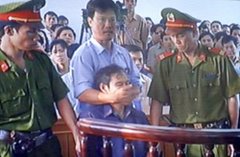
General view of the trial of three dissidents at Ho Chi Minh-City People's Court, 10 May 2007
Lawyers Nguyen Van Dai and Le Thi Cong Nhan are members of the Vietnamese democracy and human rights group "Bloc 8406," and had organized seminars for students on international human rights law.
On Friday, a court in Hanoi sentenced Dai to five years in prison and Nhan to four years. Head judge Nguyen Huu Chinh pronounced them guilty under Article 88 of Vietnam's criminal code, for spreading propaganda against the Socialist Republic of Vietnam.
Chinh says that the seminars Dai opened in December 2006 spread propaganda against the state, and defamed former Vietnamese leader Ho Chi Minh.
Dai and his lawyer denied the charges.
Dai says the seminars simply discussed the social and political situation of Vietnam.
Nhan complained that she was not allowed to defend herself properly.
Nhan says the court's procedure violated Vietnamese regulations, and that she was not allowed to speak during the part of the trial where the accused and their lawyers mount their defense.
Nhan was convicted in part for being the spokeswoman of the Vietnam Progression Party, which was founded last year. Vietnam's Communist Party is the only legal political party in the country.
The prosecution is part of a broad crackdown against Vietnam's small democracy movement, which gained strength through 2006. Since the beginning of this year, the government has detained more than a dozen democracy activists.
On Thursday in Ho Chi Minh City, Le Nguyen Sang, Nguyen Bac Truyen and Huynh Nguyen Dao were sentenced to three to five years in prison. They were convicted of collaborating with Thanh Cong Do, a Vietnamese-American active in a US-based Vietnamese political party. Do was expelled from Vietnam last September.
A dissident Catholic priest, Ngyuen Van Ly, was sentenced last month to eight years in prison.
The arrests and trials in Vietnam have sparked condemnation from several Western countries and human rights organizations.
A European Union diplomat who attended Friday's trial said while it was good that foreign journalists and diplomats were allowed to observe, Vietnam should not be condemning people for peacefully expressing their views.
Dai and Nhan will not be the last democracy activists in court. Lawyer and Internet dissident Tran Quoc Hien will go on trial in Ho Chi Minh City on Tuesday.
Hanoi
11 May 2007
Two lawyers who ran a center for human rights law and supported alternative political parties in Vietnam were sentenced to prison Friday in Hanoi. Their trial came a day after three other democracy activists were convicted of similar charges in Ho Chi Minh City. Matt Steinglass reports from Hanoi that the convictions are the latest in a crackdown on democracy activists.

General view of the trial of three dissidents at Ho Chi Minh-City People's Court, 10 May 2007
Lawyers Nguyen Van Dai and Le Thi Cong Nhan are members of the Vietnamese democracy and human rights group "Bloc 8406," and had organized seminars for students on international human rights law.
On Friday, a court in Hanoi sentenced Dai to five years in prison and Nhan to four years. Head judge Nguyen Huu Chinh pronounced them guilty under Article 88 of Vietnam's criminal code, for spreading propaganda against the Socialist Republic of Vietnam.
Chinh says that the seminars Dai opened in December 2006 spread propaganda against the state, and defamed former Vietnamese leader Ho Chi Minh.
Dai and his lawyer denied the charges.
Dai says the seminars simply discussed the social and political situation of Vietnam.
Nhan complained that she was not allowed to defend herself properly.
Nhan says the court's procedure violated Vietnamese regulations, and that she was not allowed to speak during the part of the trial where the accused and their lawyers mount their defense.
Nhan was convicted in part for being the spokeswoman of the Vietnam Progression Party, which was founded last year. Vietnam's Communist Party is the only legal political party in the country.
The prosecution is part of a broad crackdown against Vietnam's small democracy movement, which gained strength through 2006. Since the beginning of this year, the government has detained more than a dozen democracy activists.
On Thursday in Ho Chi Minh City, Le Nguyen Sang, Nguyen Bac Truyen and Huynh Nguyen Dao were sentenced to three to five years in prison. They were convicted of collaborating with Thanh Cong Do, a Vietnamese-American active in a US-based Vietnamese political party. Do was expelled from Vietnam last September.
A dissident Catholic priest, Ngyuen Van Ly, was sentenced last month to eight years in prison.
The arrests and trials in Vietnam have sparked condemnation from several Western countries and human rights organizations.
A European Union diplomat who attended Friday's trial said while it was good that foreign journalists and diplomats were allowed to observe, Vietnam should not be condemning people for peacefully expressing their views.
Dai and Nhan will not be the last democracy activists in court. Lawyer and Internet dissident Tran Quoc Hien will go on trial in Ho Chi Minh City on Tuesday.
Thursday, May 10, 2007
Activists sentenced in Vietnam

Activists sentenced in Vietnam Thu May 10
A Vietnamese court sentenced three pro-democracy activists to prison Thursday after convicting them of spreading subversive propaganda, as the communist country continued its latest crackdown against dissent.
Prosecutors said the three had collaborated with Cong Thanh Do, a Vietnamese emigre from San Jose, Calif., who was expelled from Vietnam in September after authorities accused him of plotting against the communist government.
Le Nguyen Sang was sentenced to five years, Nguyen Bac Truyen to four years, and Huynh Nguyen Dao to three years.
They were found guilty of violating Article 88 of Vietnam's criminal code, which broadly prohibits disseminating information harmful to the state.
The U.S. Embassy in Hanoi released a statement saying it was "deeply troubled" by the convictions.
"We're not aware of anything to indicate that these individuals were engaged in activities that conflict with their right to peaceful expression of political thought, widely recognized under international law," the statement said.
The convictions came in the wake of a "disturbing increase" in the harassment of dissidents, the embassy said. "We call on the government of Vietnam to release these individuals and allow for the peaceful expression of political views without fear of recrimination."
On Friday, two well-known Hanoi human rights lawyers, Nguyen Van Dai and Le Thi Cong Nhan, will go on trial on similar charges.
Hours before the trial began, Hanoi released a political prisoner who had been detained for more than two decades and allowed him to fly to the United States to be reunited with his family.
Authorities released Phan Van Ban We, who had been imprisoned since 1985 after he joined an organization calling for political change. Ban, a former policeman from the city of Dalat, left Vietnam on Wednesday night and flew to the U.S., where he was to be reunited with a son who is an American citizen.
Vietnamese President Nguyen Minh Triet granted a pardon to Ban on April 25, citing his advancing age and desire to be reunited with his family, according to the Vietnam News Agency. Ban was born in 1937, though his exact age was immediately clear.
The U.S. Embassy issued a statement Thursday welcoming Ban's release.
"He was held in prison for more than 20 years after peacefully calling for political change in Vietnam," the statement said. "We are pleased that Mr. Ban will soon be able to join his family in the United States.
Three activists jailed in Vietnam

Three dissidents in Vietnam have been jailed for up to five years for spreading anti-Communist propaganda.
They were found guilty of being members of a banned political party and having links to a Vietnamese-American activist expelled from Vietnam last year.
The authorities have recently stepped up a campaign to silence dissent, and several activists have been jailed.
An ex-prime minister, with links to the current leadership, told the BBC there should be a dialogue with dissidents.
In a rare interview, Vo Van Kiet - a reformist who was prime minister from 1991 to 1997 - said the government should not avoid "talking to those who have a different view".
And he urged the authorities "not to execute administrative measures" in their dealings with dissidents.
'Legal acts'
The three jailed activists were said to be members of the banned People's Democratic Party, which campaigns for a multi-party system of government.
Le Nguyen Sang, 48, was sentenced to five years in jail, Nguyen Bac Truyen, 39, received four years and Huynh Nguyen Dao, 39, was given three years.
They were found guilty of violating article 88, which bans disseminating information harmful to the state.
Prosecutors said they had "carried out activities that aimed to end the leadership of the Communist Party of Vietnam, demanding pluralism and a multi-party system".
The three were also accused of collaborating with Cong Thanh Do, who emigrated from Vietnam to the US in the 1980s.
Do was arrested while on holiday in Vietnam and deported last September by the authorities, who accused him of plotting to overthrow the government.
Do himself condemned the sentences, saying the three had committed no crimes.
"To advocate freedom of expression, to exercise freedom of association and to seek or exchange information by peaceful means are legal acts," he was quoted by the Associated Press as saying.
Two prominent human rights lawyers in Hanoi are expected to go on trial on Friday, also accused of defaming the state.
Another lawyer faces the same charge at a court hearing scheduled for next week in Ho Chi Minh.
A Catholic priest and rights activist was jailed in March for eight years on charges of disseminating information to undermine the state.
Subscribe to:
Posts (Atom)